.png?w=500&h=200)
I. Classification and Basic Concepts of Filters
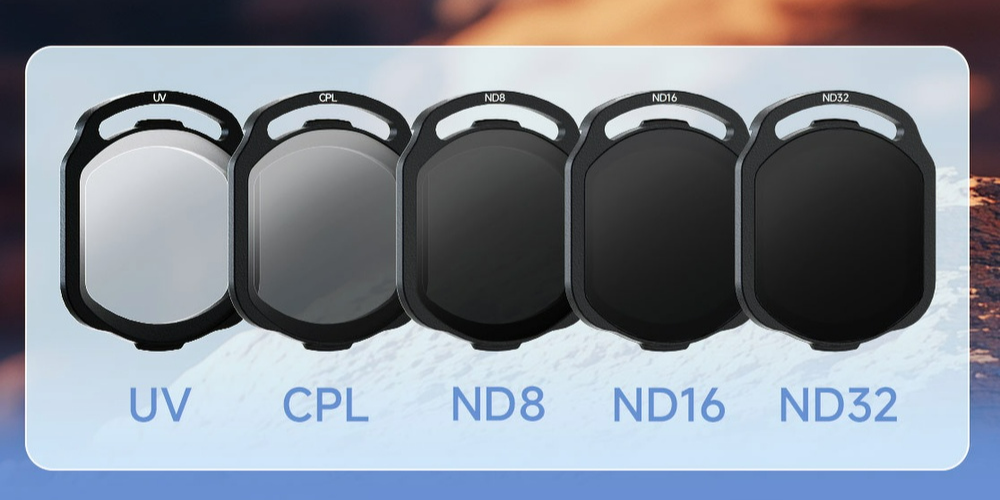
UV Filter (Ultraviolet Filter)
Appearance: Transparent or light blue lens, installed at the front of the lens.
Core Function: Protect the lens from scratches, dust and accidental collisions, filter ultraviolet rays, reduce the blue phenomenon of the picture, and improve image sharpness.
ND Filter (Neutral Density Filter)
Principle: Reduce light transmittance through multi-layer coating, do not change the color of light, only control the amount of light entering.
Core Function: Extend exposure time in strong light environment, solve the "jelly effect" (image distortion) and dynamic blur caused by too fast shutter when flying across the aircraft at high speed.
CPL Filter (Polarizer)
Structure: Consists of two lenses, which can be rotated to adjust the polarization angle.
Core Function: Eliminate mirror reflections of objects such as water, glass, and metal, enhance the color saturation of scenes such as the sky and vegetation, and make the picture more vivid.
2. Practical application of filters in drone photography
Motion blur and jelly effect processing:
ND filters control the shutter speed (such as keeping it below 1/2000s) and cooperate with the movement trajectory of the drone during high-speed flight to avoid the tearing of the picture due to the short shutter speed and restore smooth dynamic pictures.
Reflection elimination scene:
When the CPL lens is used for aerial photography of water surface and glass curtain walls of urban buildings, it can be rotated to a suitable angle to eliminate reflections and clearly present underwater objects or indoor details; when shooting natural scenery, it can deepen the blue of the sky and highlight the texture of clouds.
Lens protection and image optimization:
UV filters, as a "lens protection shield", can reduce the damage to the lens caused by sand, dust and rain during flight; at the same time, when used in high ultraviolet environments (such as plateaus and snowy areas), it can prevent the picture from being whitened and improve color authenticity.
3. Tips on using filters and matching scenes
Combination usage suggestions:
Strong light + reflective scenes (such as aerial photography of lakes on sunny days): ND filter + CPL filter are used in combination. First, the ND filter is used to control the amount of light entering, and then the CPL filter is used to eliminate reflections.
Daily flight protection: Install a UV filter separately to take into account both protection and basic image quality optimization.
Flying drone brand adaptation:
For the lens size of mainstream drones/model aircraft equipment such as DJI (such as 25mm, 30mm, etc.), select filters with corresponding calibers to avoid dark corners.
4. Extended knowledge: linkage between filters and shooting parameters
The "gear" of the ND filter (such as ND4, ND16, ND64) represents the intensity of light reduction. The larger the value, the less light enters. ISO and shutter speed need to be adjusted synchronously to ensure accurate exposure.
The polarization effect of the CPL filter is related to the angle of light. When the light is 90° with the lens, the reflection elimination effect is best. When shooting, the changes in the picture can be observed in real time by rotating the lens.


